
Why supplier selection is more than a price comparison
For MMO titanium anodes, supplier evaluation should cover shape manufacturing as well as coating direction, current density, electrolyte compatibility, installation interface, documentation package and expected service environment.
A low unit price can be attractive at the RFQ stage, but a wrong anode configuration may create much higher cost later through short service life, unstable current distribution, unexpected maintenance or repeated redesign. A useful supplier comparison should therefore start from application data rather than catalogue names alone.
1. Start with the application and reaction environment
The same MMO anode form can be used in different environments, and the coating and structure may need project-specific adjustment. ICCP, electro-chlorination, electrowinning, electroplating, wastewater oxidation and laboratory electrolysis each have different operating priorities.
- ICCP projects usually require cooperation with the CP designer around current output, cable connection, installation method and design life.
- Electro-chlorination and sodium hypochlorite applications require feed-water or brine data, scaling tendency, flow, temperature and available chlorine target.
- Electrowinning and electroplating projects need electrolyte composition, metal ion concentration, current density and equipment interface data.
- Wastewater oxidation enquiries are best reviewed with water-quality information, reactor design assumptions and electrode material together.
2. Coating selection should be linked to real operating conditions
MMO, DSA-type, Ir-Ta, Ru-Ir, platinized titanium and other coating directions are application-specific categories. A responsible supplier should ask for the electrolyte, pH, temperature, chloride or sulfate content, current density and expected duty cycle before recommending a coating system.
When these inputs are missing, a supplier can only provide a preliminary reference. A quotation that looks precise but ignores the process environment may lead to later disagreement on service life, voltage, performance or acceptance criteria.
3. Mechanical configuration matters as much as coating
An industrial anode is part of an equipment interface. Drawings, active area, titanium thickness, connection method, mounting holes, cable sealing, busbar position and installation restrictions all affect manufacturability and long-term use.
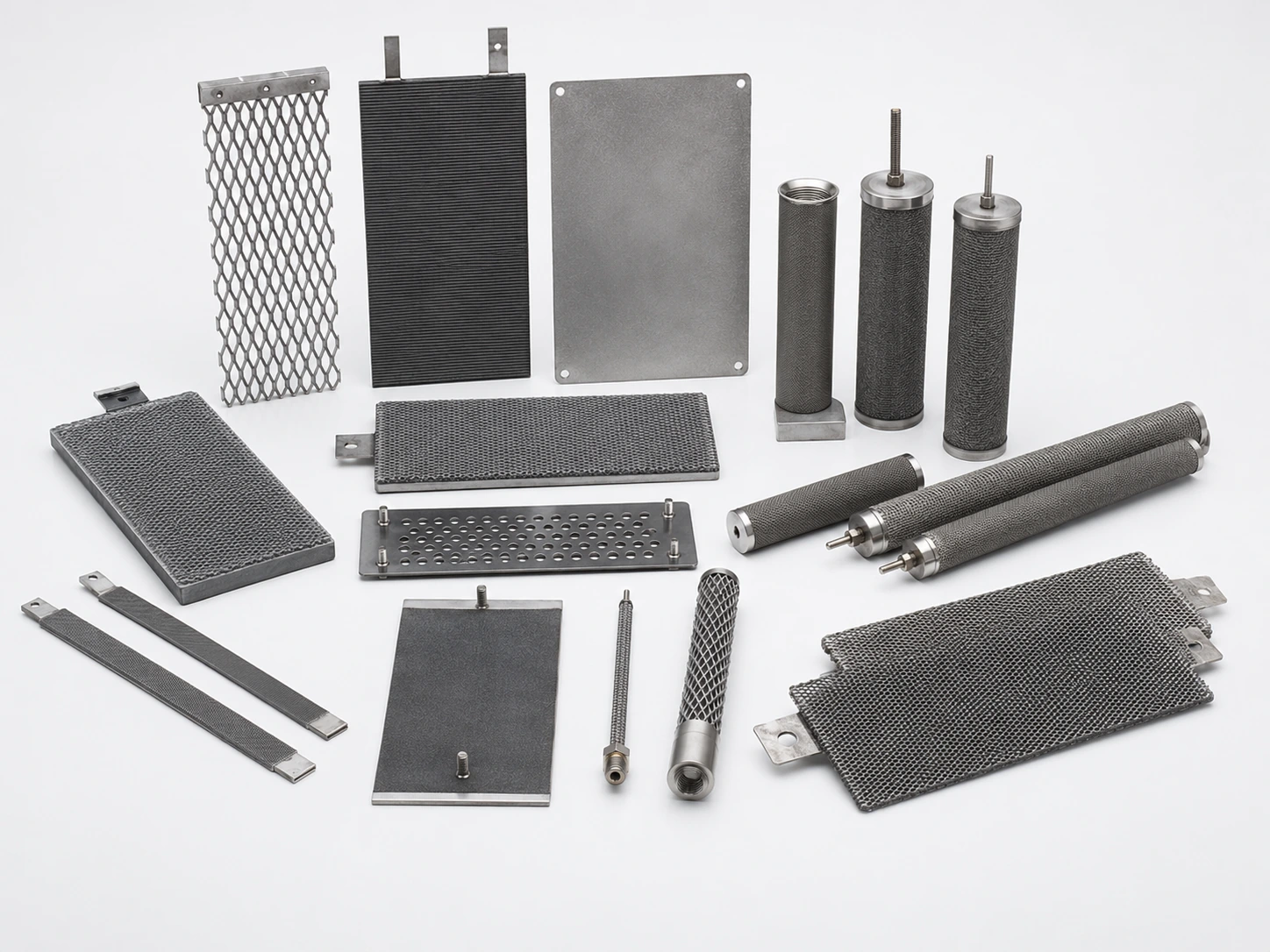
- Plate and mesh anodes may be selected when active surface distribution is important.
- Tubular, ribbon or wire anodes may be relevant for cathodic protection applications.
- Custom frames, tabs, hangers or cable assemblies may be required for equipment integration.
- Single-side, double-side or partial coating should be clarified before quotation.
4. Documentation and quality control are part of supplier value
For industrial buyers, documentation is often as important as the product itself. Useful documents may include material information, dimensional inspection records, coating-related inspection notes, packaging details, export documents, supplier qualification files or project-specific certificates where applicable.
Before selecting a supplier, confirm what documents can be provided as standard and which documents require project-specific review. This avoids surprises during supplier registration, customs clearance, FAT preparation or internal quality approval.
5. Common mistakes in MMO anode RFQs
- Comparing suppliers only by anode size and price.
- Sending a drawing without electrolyte or current density information.
- Assuming one coating system fits all chloride, sulfate, acid or wastewater conditions.
- Requesting a service-life commitment before operating conditions are confirmed.
- For CP projects, asking an anode supplier to replace the role of the CP system designer.
- For wastewater projects, expecting a predetermined COD-removal result from an anode plate alone.
6. Practical supplier checklist
Before comparing MMO titanium anode manufacturers, prepare or request the following:
- Application and process objective.
- Electrolyte, pH, temperature, chloride/sulfate/acid level and contaminants.
- Current density, total current, voltage range and duty cycle.
- Dimensions, drawings, connection method and installation interface.
- Expected service environment and maintenance plan.
- Documentation required for procurement, quality review and delivery.
- Whether the project is component supply, electrode assembly, cell unit or broader equipment discussion.
How TJNE reviews MMO anode enquiries
TJNE starts from operating conditions and project scope before recommending an anode configuration. For cathodic protection projects, TJNE focuses on MMO auxiliary anodes and related electrode components based on the CP designer's input. For water and wastewater applications, TJNE reviews electrode and cell configuration after basic water data is available. For electrolysis and plating projects, coating direction, substrate form and connection details are reviewed together with the actual process environment.
This approach is intended to reduce procurement risk and help the buyer compare suppliers on equivalent technical terms, rather than on incomplete catalogue descriptions.